Three parts. What was done to a people and the state papers that record it. What was later done to their faith and who did it. And how we work, including the claims we tested and threw out.
Fourteen sections in three parts. Go straight to any of them.
What was done to a people, and the state papers that record it.
How a mortal man was made into a Messiah, and who did it.
How we work, including what we tested and dropped.
One chain of documents, in order. If you read nothing else on this page, read this.
The Cromwellian and Jacobite shipments out of Ireland and Scotland, the people who were carried, and the surname puzzle they left behind in Jamaica. Every source quoted in full and downloadable.
We are not asking you to take our word for anything. The records are public, and we will put them in your hands.
In May 1747, a ship called the Veteran sailed from Liverpool carrying 150 Jacobite prisoners to be sold into indenture in the Leeward Islands. Before she sailed, a clerk wrote out an exact list of everyone aboard: name, age, trade, county and a physical description of each prisoner.
That document survives. It sits in the National Archives as SP 36/102/38, and it was published in full in 1903. Prisoner number 132 reads as follows.
“George Hume, aged about 30. Writer. Edinburgh. Black man.”An Exact List and Description of 150 Rebel Prisoners ship'd at Liverpool on board the Veteran, May 1747. Published in J. Macbeth Forbes, Jacobite Gleanings from State Manuscripts, Edinburgh, 1903. Freely readable on the Internet Archive.
A Black man, a legal writer, from Edinburgh, who fought for the Jacobite cause and was transported for it. Not a servant. Not a curiosity in the margins of somebody else's history. A Scot, with a trade and a name, in the historical record, written down by the very officials who were deporting him.
He is not the only one. The same manifest describes other prisoners as black and swarthy. Four decades earlier, records place African men and women at the court of Scotland in Edinburgh and at Leith. And the ships that sailed from these shores connected the Highlands, the Caribbean and West Africa in ways the tourist version of Scottish history rarely mentions.
Then, in the same year George Hume was put on that ship, Parliament passed the Act of Proscription. Tartan, the kilt, the plaid and the pipes were outlawed. A culture was legislated out of visibility, and what came back a century later came back curated.
So this is why we gather in Scotland. Because the story of who was here has been thinned out and tidied up, and there is a fuller record underneath it that is worth standing on the actual ground to learn.
These three plates are artists' depictions, painted to help us picture people the written record describes. They are illustrations, not photographs or historical artefacts. The history itself rests entirely on the documents, and we will show you the documents. They are all here, in full.
Those portraits are the past. This is the point of the whole thing: we are still here, and we are coming back to claim it.
The tartan was never a costume borrowed from somebody else's family. Black Watch green, the deep blues, the greens against black: these are the colours of the country our line ran through, and wearing them is not fancy dress. It is a homecoming.
We will wear them at the gathering. Not as a theme night, but because the men and women who come will stand on that ground looking exactly like this, and something settles in a person when they see themselves in the picture at last.
What it is, who wrote it, what it says in its own words, and where it is weak.
Concerning the younge women, although we must use force in takeinge them up, yet it beinge so much for their owne goode, and likely to be of soe great advantage to the publique, it is not in the least doubted, that you may have such number of them as you shall thinke fitt.Henry Cromwell to Secretary Thurloe, 11 September 1655. Vol. 4, pp. 23–24.
I think it might bee of like advantage to your affaires their, and ours heer, if you should thinke fitt to sende 1500 or 2000 younge boys of 12 or 14 yeares of age to the place aforementioned … make them English–men, I meane rather, Christianes.Henry Cromwell to Secretary Thurloe, 18 September 1655. Vol. 4, p. 40.
The comittee of the counsell have voted 1000 girles, and as many youthes be taken up for that purpose; and that there be a summe of money for each head allowed for the clothinge of them, and other necessaryes to the water-side.Secretary Thurloe to Henry Cromwell, about 10 October 1655. Vol. 4, p. 75.
The ships, which are next to goe thither, will be appointed to take on board them the Irish women or girles. It is agreed to provide their clothes here, and to put them in the aforesayd ships to be ready for them against such tyme as they come on board … The tyme that they must be at the port wil be about the latter end of December … which we thinke wil be Galloway.Secretary Thurloe to Henry Cromwell, 23 October 1655. Vol. 4, pp. 100–101.
In the course of four years they had seized and shipped about 6,400 Irish, men and women, boys and maidens, when on the 4th of March, 1655, all orders were revoked.Prendergast, p. 92 area, citing archive reference A(10), p. 283.
These men-catchers employed persons to delude poor people by false pretences into by-places, and thence they forced them on board their ships. The persons employed had so much a piece for all they so deluded … and they had not only dealt so with the Irish, but also with the English, which last was the true cause, probably, of the Commissioners for Ireland putting an end to these proceedings.Prendergast, on the revocation of the orders, 4 March 1655.
Captain John Vernon was employed by the Commissioners for Ireland into England, and contracted in their behalf with Mr. David Sellick and Mr. Leader under his hand, bearing date the 14th September, 1653, to supply them with two hundred and fifty women of the Irish nation above twelve years, and under the age of forty-five, also three hundred men above twelve years of age, and under fifty, to be found in the country within twenty miles of Cork, Youghal, and Kinsale, Waterford, and Wexford, to transport them into New England.Prendergast, citing A(84), p. 663.
Daniel Connery, a gentleman of Clare, was sentenced … to banishment, in 1657, by Colonel Henry Ingoldsby, for harbouring a priest. This gentleman had a wife and twelve children. His wife fell sick, and died in poverty. Three of his daughters, beautiful girls, were transported to the West Indies, to an island called the Barbadoes; and there, if still alive (he says) they are miserable slaves.Prendergast, quoting Morison, Threnodia Hiberno-Catholica, Innsbruck, 1659, p. 287.
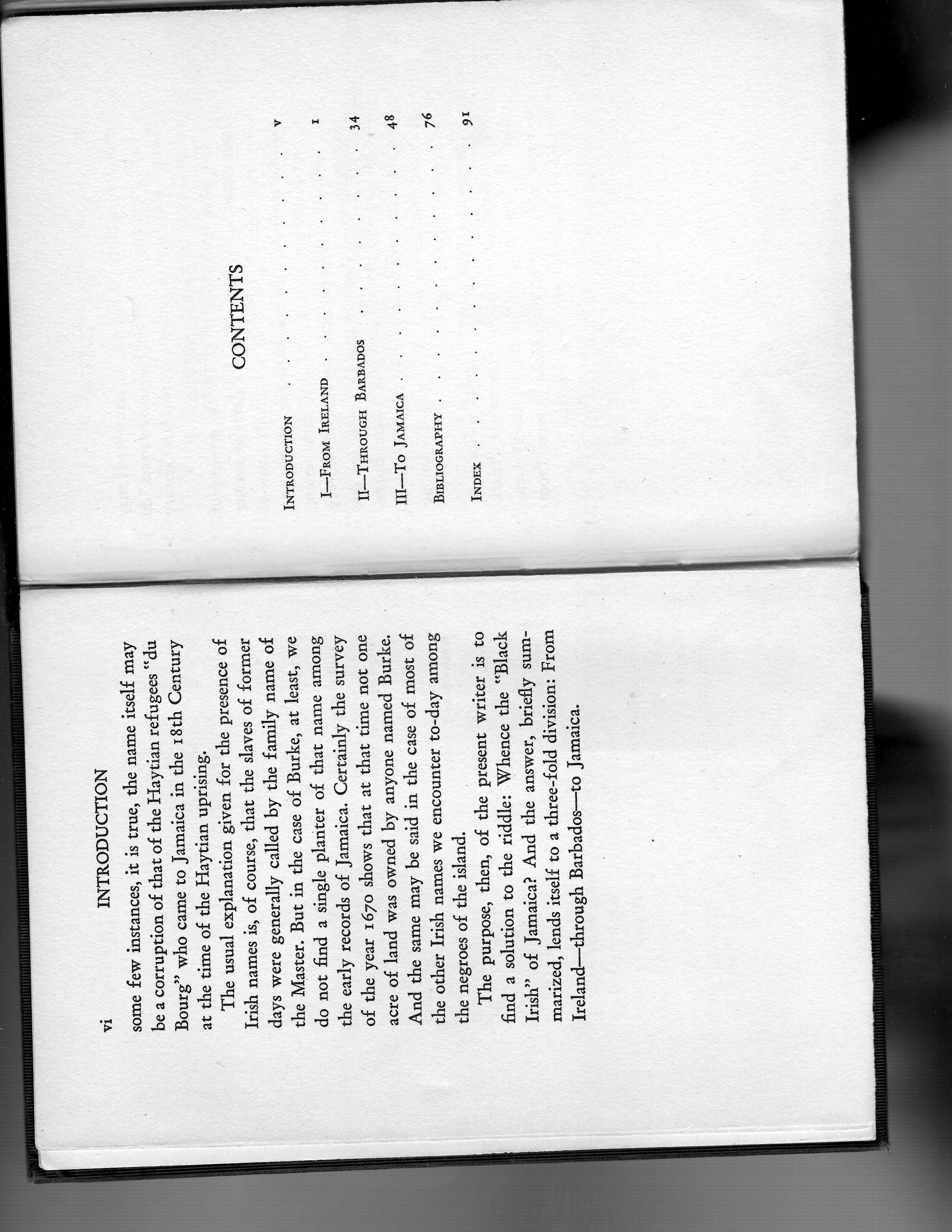
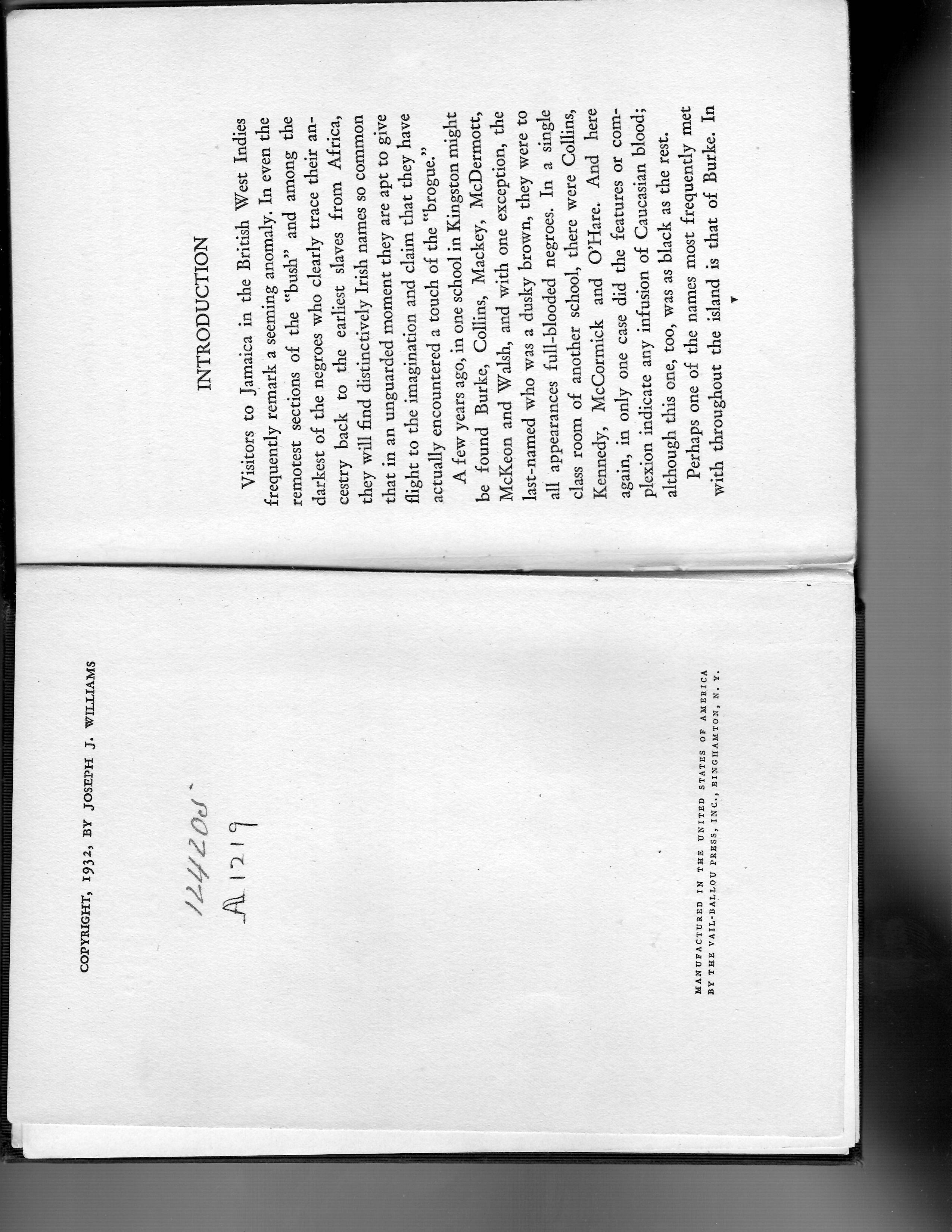
Visitors to Jamaica in the British West Indies frequently remark a seeming anomaly. In even the remotest sections of the “bush” and among the darkest of the negroes … they will find distinctively Irish names so common that in an unguarded moment they are apt to give flight to the imagination and claim that they have actually encountered a touch of the “brogue.”Williams, Introduction, p. v.
The usual explanation given for the presence of Irish names is, of course, that the slaves of former days were generally called by the family name of the Master. But in the case of Burke, at least, we do not find a single planter of that name among the early records of Jamaica. Certainly the survey of the year 1670 shows that at that time not one acre of land was owned by anyone named Burke. And the same may be said in the case of most of the other Irish names we encounter to-day among the negroes of the island.Williams, Introduction, p. vi.
The Inhabitants of this Isle are generally well proportion'd, and their Complexion is for the most part black.Martin Martin, on the Isle of Skye, 1716, p. 194.
The Natives here are very well proportion'd, being generally black of Complexion, and free from bodily Imperfections. They speak the Irish Language, and wear the Plad, Bonnet, &c. as other Islanders.Martin Martin, on Jura, 1716, p. 239. The passage is followed in the original by “The Isle of Ila lies to the West of Jurah”, which fixes the island.
The Inhabitants of this Isle are well proportion'd, generally brown, and some of a black Complexion.Martin Martin, 1716, around p. 224.
There was an Edinburgh writer, George Hume, age 30, marked as a ‘Black man,’ whose colour would, no doubt, suit the West Indies.Forbes, Jacobite Gleanings, 1903, describing entry 132 of the Veteran list. The words after the comma are Forbes's own, written in 1903.
These are complete books, not extracts. All of them are out of copyright. Download them, search them, and check every line we have quoted.
| Source | Date | What it gives you | Download |
|---|---|---|---|
| Joseph J. Williams, Whence the “Black Irish” of Jamaica? | 1932 | The surname puzzle and the 1670 Jamaica land survey argument | PDF, 63 pages |
| J. P. Prendergast, The Cromwellian Settlement of Ireland | 1865 | The seizure orders, the named contractors, and the 6,400 figure | Text, 183,000 words |
| Martin Martin, A Description of the Western Islands of Scotland | 1716 | Island by island eyewitness descriptions of the Hebrides | Text, 99,000 words |
| Richard Ligon, A True and Exact History of the Island of Barbados | 1657 | Contemporary eyewitness Barbados, written by a resident | Text, 81,000 words |
| J. M. Forbes, Jacobite Gleanings from State Manuscripts | 1903 | The Veteran prisoner manifest, SP 36/102/38, printed in full | Text |
| John Thurloe, A Collection of the State Papers | 1742 | The Jamaica correspondence of September and October 1655 | Read free, British History Online |
| Williams's own bibliography, transcribed | 1932 | Roughly 180 sources he worked from, with the fifteen that carry the evidence marked | Markdown |
| Our working notes on the primary evidence | 2026 | Every passage above with its archive reference, as we recorded it | Markdown |
How a mortal man was made into a Messiah, who manufactured it and when, what he himself said about it, and what Marcus Garvey wrote. Also what the movement got right, which matters as much.
The whole structure rests on one claim: that Haile Selassie I was the Messiah returned. The simplest way to test it is to ask the man. He was asked, on the record, by a Canadian broadcaster in 1967, and he answered.
I have heard of this idea. I also met certain Rastafarians. I told them clearly that I am a man, that I am mortal, and that I will be replaced by the oncoming generation, and that they should never make a mistake in assuming or pretending that a human being is emanated from a deity.Haile Selassie I, interviewed by Bill McNeil for the CBC, 1967, recorded aboard the royal train in Canada. Quoted in Erin MacLeod, Visions of Zion, New York University Press, 2014, p. 70. The CBC audio is public domain.
If you want the single point on which this whole page turns, it is this one. The divinity claim did not grow slowly out of misunderstanding. There is a document, and a date.
Marcus Garvey is held up as the prophet of the movement. He is credited with telling people to look to Africa for the crowning of a king. That prophecy has never been traced to anything Garvey wrote. Barry Chevannes traces the legend instead to a play staged at a Jamaican convention in 1929 which ended with the crowning of an African king.
What Garvey certainly did write is a signed editorial in his own newspaper in 1937, after the Italian invasion. It is public domain and anyone can read it.
After all, Haile Selassie is just an ordinary man like any other human being.Marcus Garvey, The Failure of Haile Selassie as Emperor, The Black Man, vol. 2 no. 6, March to April 1937. Reprinted in the Marcus Garvey and UNIA Papers, University of California Press, vol. 7.
This is the part of the story most often told loudest and sourced least. So we have done it the other way round. Every claim below is set out as it is usually put, then answered with the actual words of the actual document, then given a verdict. Where the document helps the claim we say so. Where it destroys it we say that too. Every paper we could reach is linked. Every paper that refused us is named at the end.
The CIA ran a destabilisation programme against Michael Manley's government in 1976.
“Jamaica is the centerpiece and Castro is having success in developing close ties with Prime Minister Manley.”
And the stated aim of the food aid programme Ford approved that September was to make it harder for Manley “to continue using the ‘destabilization’ theme as a campaign issue.”
Kissinger to President Ford, 26 August 1976, Confidential; and Scowcroft to Ford, 20 September 1976. Gerald R. Ford Presidential Library, Presidential Handwriting File, Box C49, folder 9/24/1976. Ford approved the 2.5 million dollar programme on 24 September 1976.
American hostility to Manley is documented beyond argument. A 1976 destabilisation operation is not. The three intelligence papers in the published record are assessments, not operations, and contain no covert action options. The one action Ford actually approved in the run up to the election was school feeding aid, approved precisely to blunt the destabilisation charge. That is not proof that nothing happened, because covert action records are the category most often withheld. It does mean the 1976 claim has no documentary leg to stand on yet.
There was never any real American plan to remove Manley. That is just Rasta folklore.
“Establish direct confidential contact with Edward Seaga, the leader of the main opposition party, the Jamaican Labor Party (JLP) and also provide guidance, assistance and funds to the JLP in the upcoming Jamaican national election campaign.”
“Our ultimate aim is either the political defeat of Manley and the replacement of his government with one more friendly to the U.S. and appreciative of U.S. interests, or, at a minimum, the application of enough pressure on Manley and his People's National Party…”
CIA memorandum for the Special Coordination Committee, Foreign Relations of the United States 1977 to 1980, Volume XXIII, Document 197. We checked both passages word for word against the published text.
There was a real proposal, in the CIA's own words, to make confidential contact with Manley's opponent, to fund his opponent's party, and to replace his government. Anyone who says the idea was pure invention has not read the file.
And here is the correction we have to make in the same breath, because it is the single most important fact in this section. That proposal is dated 1978 to 1979 and it targets the 1980 election. It is not the 1976 programme. At the Special Coordination Committee meeting of 23 October 1979 the political proposal was found premature, Brzezinski ordered a fuller review, and the committee authorised only propaganda in support of existing policy. The American ambassador of the day is recorded as opposed to any covert action in Jamaica at all. So the documents prove the intent existed and prove it was held back, three years after the year everyone cites.
Manley himself said the CIA was destabilising his government, and he would know.
The American ambassador asked him directly whether he believed the State Department had urged destabilisation of Jamaica. The cable records the answer:
“No, I don't believe anything is being done now. I did once, but not now.” And a moment later: “That chapter is now closed.”
Of his own Foreign Minister's destabilisation speech, Manley said he did not entirely agree with Dudley Thompson's remarks, describing him as “posturing in a highly charged atmosphere.”
Ambassador Gerard, reporting a meeting with Manley on 3 September 1976. Embassy telegram, 6 September 1976, FRUS 1969 to 1976, Volume E-11 Part 1, Document 467. We read the cable itself, not a summary of it.
Three months before the shooting, in private, the man with every political reason to blame Washington told the American ambassador that he no longer believed it was happening. In 1977 he still maintained some CIA people had tried, but accepted that top officials likely gave no direct orders, claimed his intelligence was irrefutable and would not produce it. And in 1983 he conceded in public that they had never found the smoking gun. We publish this because it cuts against the easy version, and a case that hides its own worst document is not a case.
Norman Descoteaux was the CIA Chief of Station in Kingston, running the operation.
A State Department cable records the press conference at which the names were read out: nine embassy staff “including the embassy attache whom he said was the CIA chief of station and his wife.”
The official American response, recorded in the same traffic: “it is the policy of the United States Government not to comment on allegations of this kind.”
Embassy Kingston cables 1976KINGST03978 and 1976KINGST03998, and State 230641, all 16 to 17 September 1976, reproducing the list given by Philip Agee.
That the naming happened is documented. That the naming was correct is not. No American government confirmation has ever been given, and every later retelling traces back to the same one man. Two things have to be said about him. He was, by the account of his own colleague at his memorial, in Jamaica alongside someone who had come to work for Manley's re-election campaign, so he was naming the station while working for the incumbent. That does not make him wrong, but it does stop him being disinterested. And his list contained errors: the embassy flagged one named woman as a Canadian national working in the passport section, and another man on the list went on to an entirely conventional diplomatic career as ambassador to Uganda, chief of mission in Addis Ababa, deputy assistant secretary for African affairs, and first American ambassador to Eritrea.
The CIA shot Bob Marley at 56 Hope Road on 3 December 1976.
The strongest version on the record is Don Taylor's, Marley's manager, who was shot that night. In his 1995 memoir he reported a people's court at which a gunman said that those involved had been CIA trained and paid in guns and cocaine, and that a senior agent had been in the film crew.
Against it stands the only researcher who interviewed the eyewitnesses systematically over four decades. Roger Steffens gives the shooting roughly forty pages and found no concrete evidence of CIA involvement.
Don Taylor, Marley and Me (1995). Roger Steffens, So Much Things to Say (2017). Netflix, ReMastered: Who Shot the Sheriff? (2018), which reached no proven answer.
What is documented is the attack itself. On the evening of 3 December 1976 armed men came into the yard. Bob Marley was shot in the chest and arm, Rita Marley in the head while sitting in her car, Don Taylor in the legs and torso, Louis Griffith in the torso. Nobody died, and nobody was ever charged. Marley played the Smile Jamaica concert two days later, wounded.
What is not documented is who sent them. The CIA version rests on a late, single source, second hand confession attributed to a man reportedly killed afterwards, with no contemporaneous record of the court at which it was supposedly given. That is close to the lowest grade of evidence there is. The ordinary explanation fits every known fact: Jamaica's garrison politics, a snap election called on 22 November after the concert was already scheduled, a singer the opposition read as endorsing the government, and gunmen who in that system were routinely never charged. We cannot prove either account, and we will not pretend otherwise.
A CIA man gave Marley a pair of boots with a wire in them, and that is what gave him the cancer that killed him.
The story comes from one cinematographer, Lee Lew-Lee, who said he saw Carl Colby bring Marley new boots, and a wire pulled from inside one of them. It was written up in 2000 and has circulated ever since. Colby denies it.
Alex Constantine, The Covert War Against Rock (2000), popularised from 2002 onward. Colby's presence in Jamaica filming the concert is separately documented.
We would rather lose a good story than keep a false one, and this one is false. The medicine settles it. Marley had acral lentiginous melanoma of the right great toe, confirmed by biopsy at Munich in June 1977 and read by two independent pathologists. That cancer is a melanocytic disease which falls disproportionately on people with darker skin. It is not caused by puncture wounds or by wires. The clinical literature is explicit that the football injury revealed the lesion rather than caused it, and records Marley describing a mark at that spot on and off for years before December 1976, on his own account.
Two further marks of folklore. The story mutates: the gift is cowboy boots, or Converse, or size ten sneakers; the agent is Colby, or a man called Bill Oxley who never existed; the wire is copper, or radioactive, or infected. And its most shared version, the Bill Oxley deathbed confession, was simply invented by a fake news site and taken apart by Channel 4's FactCheck, which found the photograph was a doctored Polish stock image, no such officer traceable, and the named hospital confirming no such patient.
What is true is that Carl Colby was in Jamaica, filming, and was the son of the Director of Central Intelligence. That coincidence of identity is the whole engine of the legend. A coincidence is not an act.
The descent of the Ethiopian royal house from Solomon and the Queen of Sheba, through a son named Menelik, comes from a book called the Kebra Nagast.
Set that against what the scriptures themselves record. In 1 Kings 10 and 2 Chronicles 9 the queen of Sheba comes to Solomon, they exchange gifts, and she goes home to her own country. There is no child in the account. The child enters the story roughly 2,300 years later, in a document written to legitimise a dynasty that had taken the throne by force four decades earlier.
The movement is often spoken of as though it began with the music. The dates say otherwise, and the dates are not in dispute.
We are not going to tell people who kept a commandment that they were wrong to keep it. On the hair, they read the text and they acted on it, and the text is on their side.
The hair is not a side effect of the vow. The text calls it a crown.
The same habit that made a man into a Messiah made a painting into a photograph. Here is where the familiar image actually comes from.
The strongest case against us, the questions still open, and a record of the claims we tested and dropped. A page that only shows one side invites the reader to assume the rest was hidden.
Here is what an informed Rastafari scholar would say back to this page. We would rather put it here ourselves than have it produced as though we had hidden it.
This page would be easy to write if we kept everything that helped us. We have not done that. Below is every claim we went looking for, wanted to be true, and then threw out, with the reason it failed. Some of these are claims we had already written up before we caught them. One of them was our own mistake about our own source. We would rather you found them here, from us, than found them later and wondered what else we were holding.
Of 717 named landholding families in the surveyed parishes of Jamaica, only two carry Gaelic pattern names.
This was in our own working brief, attributed to Joseph J. Williams. Two of our researchers went to check it and came back contradicting each other. So a third went and read Williams's 1932 text itself, which we had held the whole time, and the two names the brief quoted are not in it in the form we gave them.
Our own research note, withdrawn. Williams, Whence the Black Irish of Jamaica (1932), read in full and available on this page.
A bad summary of a source we could have opened at any time nearly became a published finding, and it would have inverted what the source actually says. That is the worst kind of error because it looks like scholarship. It is the reason every claim on this page now has to name the document it rests on, and the reason we say, each time, whether we read the thing itself or are trusting someone who said they did.
There is a book called Marcus Garvey and His White Friends.
We searched HathiTrust, the Internet Archive and Open Library on full text, each time running a control search for a title we knew existed so we could prove the search itself was working. Every control returned results. Every search for this title returned zero.
Google Books, WorldCat and the Library of Congress refused our requests, so we cannot speak for those catalogues. The British Library returned nothing but its control also failed, so we discard that result rather than count it.
Three high coverage full text corpora reached and control tested. October 2026.
We say not found rather than does not exist, because three catalogues refused us and an honest search reports its own blind spots. If you hold a copy, or a library record, send it and we will publish it here the same day.
And we separate this from the thing it is usually offered to prove. Whether Garvey dealt with white supremacists does not depend on this book at all. That question we answer below, on documents, and the answer is not comfortable in either direction.
White supremacists financed Garvey's repatriation programme.
The money came the other way. The organisation was financed at five dollars a share, by people of African descent, raising somewhere around three quarters of a million dollars. No white backer appears in the accounts, and that is under a hostile federal investigation, a federal prosecution, and a liquidation, any one of which would have surfaced one.
The money that is documented to have changed hands between Garveyites and Virginia white supremacists flowed from Black buyers to a white author: roughly seventeen thousand copies of his book sold in Detroit alone.
Garvey and UNIA records, Bureau of Investigation files, the 1923 prosecution and the liquidation record.
We drop the funding claim. We keep, because it is documented and it is damning on its own terms, that Garvey met with, platformed and promoted white supremacists. He did not need their money to have done that. Dropping the false half makes the true half harder to dismiss, which is the entire reason for doing it this way.
There is a photograph of Queen Elizabeth II bowing to Haile Selassie.
It is an Alfred Eisenstaedt photograph taken in Ethiopia in 1955 for Life. The Queen did not set foot in Ethiopia until February 1965. Empress Menen is in the frame, and she died in 1962. The woman in the picture is not the Queen.
Life Picture Collection via Getty. Four independent fact checks reach the same conclusion.
Dropped completely. And we note the variant that adds Prince Charles to the same picture: he was about seven years old in 1955.
What is documented, and is more interesting than the fake, is that the two met twice as heads of state. She received him in London in October 1954 and made him a Stranger Knight of the Garter. He received her in Addis Ababa in February 1965. A reigning sovereign does not bow to another head of state, which is why no such photograph exists to be found.
The face on the church wall is Cesare Borgia, swapped in to replace the real likeness.
The bearded, long haired, centre parted type is fixed in Christian art by about the fourth century. Borgia was born in 1475. The type predates him by roughly a thousand years, so he cannot be its origin.
The portrait usually circulated as Borgia is by Altobello Melone, around 1513, and its identification is itself disputed. And the two books everyone cites for the claim, Hislop and Dumas, do not contain it. We searched both texts. The citation was invented somewhere downstream and has been copied ever since.
Text searches of both cited works; art historical dating of the bearded type.
Dropped. The real history underneath is better than the legend: the face was assembled by artists out of Zeus, Jupiter, the philosopher type and imperial portraiture, which is a documented act of invention. You do not need a Borgia to make that point.
Santa Claus comes from Santa Maria, a name for cannabis.
Santa Maria really is a sacramental name for cannabis. It was given in the Amazon by Padrinho Sebastião Mota de Melo in the middle to late nineteen seventies, in one branch of Santo Daime. That part is solid.
Santa Claus is attested in American English in December 1773, and its Dutch parent Sinter Niclaus in 1297, from Nicholas of Myra. The cannabis name is roughly two hundred years younger than the English word and seven hundred years younger than the Dutch one.
Dated attestations in both languages; Santo Daime's own history.
We were asked specifically to carry this one with a disclaimer, in case later evidence made it true. We have not done that, and here is why said plainly: later evidence cannot reverse the order of two dated words. Nothing found in the future will make a nineteen seventies Brazilian name the parent of a thirteenth century Dutch one.
What survives, and we think it is the stronger observation anyway, is the pattern. Religious movements have repeatedly given cannabis a holy name and a devotional reason, within living memory and in the open. Santa Maria in Brazil is the proof of that, not of an etymology.
These we tested, found false or unsupported, and are not using. Several are common in material circulated by people on our own side of these arguments, which is exactly why they are here.
| Claim | Why we dropped it |
|---|---|
| Easter comes from Ishtar | Ishtar is Akkadian, Easter is Germanic from Old English eastre, from a root for dawn. There is no route from one to the other. The resemblance exists only in modern English pronunciation. |
| Jeremiah 10 verses 3 to 5 forbids the Christmas tree | The passage describes carving a wooden idol, overlaid with silver and gold and nailed so it will not topple. The Letter of Jeremiah settles the ancient reading: a scarecrow in a cucumber field. Verse 2, learn not the way of the heathen, is sound and sufficient on its own. |
| The Christmas tree is a surviving pagan rite | First decorated trees are in guild halls at Reval and Riga in the fifteenth and early sixteenth centuries. That is a gap of roughly eight hundred years from any pagan practice anyone can name. |
| Saturnalia was on 25 December | It began on 17 December and ended around the 23rd. The defensible version is that 25 December sat inside a crowded Roman midwinter season. |
| The Yule log is a documented pagan solar rite | First recorded by Herrick in 1648 and named by Aubrey before 1687, neither of whom mentions paganism. The pagan reading was proposed by Henry Bourne in 1725 as a conjecture. |
| Mithras was born on 25 December | No ancient source gives any date for his birth or records a festival of it. He is shown emerging from a rock, undated. |
| Horus, Attis and Dionysus were born of a virgin on 25 December | Isis was Osiris's widow, not a virgin, and the relevant Egyptian festival falls in Khoiak. Dionysus was carried in Zeus's thigh. No Egyptian text supports it. |
| Nicaea fixed the date of Christmas, or Canon X set the Easter date | Nicaea did not address Christmas, and its twenty surviving canons contain no canon on the Paschal date. Anyone citing a Nicene canon for it is inventing a citation. The real evidence is Constantine's letter, and it is strong enough on its own. |
| Eggs and hares are ancient fertility symbols of Eostre | Bede, the only source for Eostre, mentions neither. The Easter Hare first appears in 1682 as a local Alsatian children's tale. |
| Ostara was a widely worshipped Germanic goddess | Ostara is Jacob Grimm's 1835 reconstruction, offered as such. Everything written about her cult depends on Grimm, not on any ancient source. |
| Ganja has Hebrew or African roots | The word is Indic: Sanskrit to Hindi and Urdu to English, reaching Jamaica with Indian indentured labour from 1845. No lexicographer supports a Hebrew or African etymology. |
| Anything whose only ancestor is Hislop's The Two Babylons | Rejected across scholarship, including by its own former popularisers. Ralph Woodrow built a best seller on it, then withdrew his own book and refuted it: building on similarities while ignoring differences is an unsound method. Nimrod and Semiramis were not husband and wife; they are separated by centuries. |
These are open questions, not claims. We have put them here so that anyone who holds the missing piece knows exactly what we need.